The 5 Non-Negotiables for Finance AI in 2025 (And the Gaps Most SMB Stacks Still Have)
Executive takeaways on what leaders should do next. From covenant-aware cash to multi-entity consolidation, make every metric provable, know when standards apply, and enforce enterprise data posture.
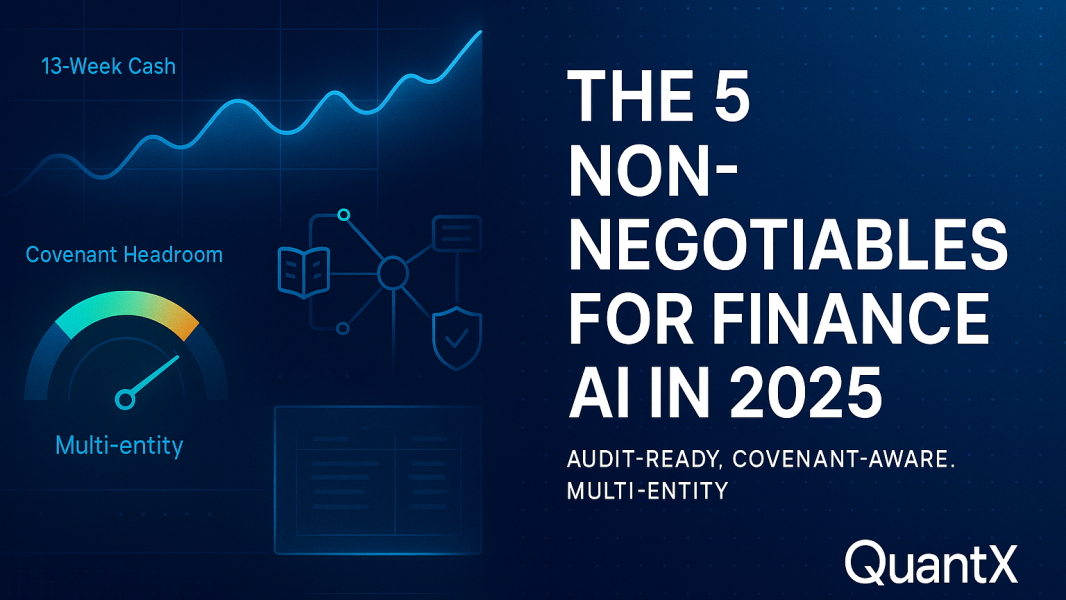
The finance AI landscape is exploding with new tools, but most SMB stacks still have critical gaps. Here are the 5 non-negotiables every finance leader needs—and what today's tools really offer.
🚨 Executive Takeaways (What Leaders Should Do Next)
1. Insist on Covenant-Aware Cash
Your 13-week view must model loan definitions (DSCR, leverage, FCCR), include overdue items, and show headroom—with alerts before breach.
⚠️ QuickBooks Reality Check: QuickBooks' built-in Cash Flow Planner is useful, but it's a planning tool that doesn't include overdue invoices/bills unless you manually set expected dates—and it's not available when Multicurrency is on. That's not lender-grade.
2. Treat Multi-Entity Consolidation as a Governed Process
QuickBooks Online Advanced points multi-company users to Spreadsheet Sync to build consolidated spreadsheets; that's a workaround, not a consolidation ledger with eliminations, FX translation, and drill-through. Your board package should click back to journals across entities.
3. Make Every Metric Provable
If a KPI or AI narrative can't click-through to ledger/bank evidence with approver IDs and timestamps, it's not audit-ready. (Most assistants don't do cross-system provenance out of the box; Copilot for Finance, for example, excels at variance/recon/collections in Excel, not group consolidation or audit-packs.)
4. Know When Standards Apply
Any valuation informing equity, M&A, buy-sell, or financing must align with AICPA VS Section 100 (SSVS). Dashboards and chat output are not compliant workpapers.
5. Enforce an Enterprise Data Posture
If you connect AI to finance data, use providers where business data isn't used to train models by default (e.g., OpenAI Enterprise/API; Azure OpenAI) and document it in policy.
🔍 What Today's Tools Really Offer (And Where They Stop)
QuickBooks AI (Planner & KPIs)
Solid: 30–90-day cash and scorecards
Gaps: Overdue AR/AP excluded by default unless you set expected dates; Planner disabled with Multicurrency; multi-company relies on Spreadsheet Sync (Excel).
Great inside the QBO garden—doesn't solve multi-entity governance or lender-grade evidence by itself.
Microsoft Copilot for Finance
Strength: Speeds variance analysis and reconciliations in Excel/Outlook with new 2025 features
Raises the productivity floor but isn't a consolidation/valuation or covenant-monitoring system.
Sector AI (e.g., Anthropic's Claude for Financial Services)
Strength: Strong research/analysis horsepower with enterprise connectors
You still own modeling, controls, and standards.
💡 Macro Trend: Even hyperscalers are pairing AI with embedded delivery teams (e.g., OpenAI's forward-deployed engineers starting $10M+ engagements) because integration/governance is where outcomes happen—not in a chat UI.
✅ The Practical Punch-List (Leaders Can Run This in a Board Meeting)
Cash & Covenants
- Do we compute DSCR/leverage/FCCR weekly from our actual loan definitions, with headroom and pre-breach alerts? (Y/N)
- Does our forecast automatically consider overdue AR/AP—not just "open" items? (Y/N)
Close & Consolidation
- Are intercompany eliminations and FX automated with drill-through to source journals? (Y/N)
- What's our days-to-close trend vs. APQC peers, and what's our target reduction this quarter? (Y/N + #)
Evidence & Approvals
- Can any KPI/AI sentence click to the underlying ledger/bank line with approver/time stamp? (Y/N)
Valuation Readiness
- When valuation affects decisions, are we VS-100 compliant (methods, assumptions, disclosures, workpapers)? (Y/N)
Data Posture
- Is it written into contracts that business data does not train provider models (OpenAI Enterprise/API, Azure OpenAI)? (Y/N)
If any answer is No, you have an execution gap—regardless of how many AI features you've turned on.
📊 Reference Pattern: What Good Looks Like in 90 Days
- ✅ Covenant-aware 13-week cash
- ✅ Governed multi-entity close
- ✅ Evidence-first analytics
- ✅ Valuation cadence (when applicable)
Why This Matters
Working-capital surveys still show big dollars trapped in receivables/inventory; top performers compress CCC meaningfully. Cutting even 5-10 DSO days can free six figures for a $10-$20M SMB, dwarfing most AI/tooling costs.
🔧 Where a "CFO Stitch Layer" Fits (Without the Sales Pitch)
Think of a thin layer that sits on top of QuickBooks/Microsoft/Claude and owns the last mile:
- Builds the pipelines & mapping (entities, COA, FX, loan terms).
- Enforces controls (maker-checker, logs, retention).
- Produces board/lender artifacts (consolidated statements with drill-through; covenant headroom reports; VS-100 valuation workpapers).
- Closes the loop by posting approved entries or triggering collections/ops tasks—not just describing the problem.
That's the role QuantPillar plays. We use QuickBooks/Copilot/Claude where they shine, then supply the governance + accountability they don't aim to provide. The win shouldn't be "prettier charts"—it's fewer days to close, fewer covenant surprises, and more cash on hand, provably.
🚀 Why This Stance Is Future-Proof (Not Just 2025)
- Vendors are racing toward agentic AI inside their gardens (Intuit, Microsoft, Anthropic). Great—let them. Your edge is the cross-system outcomes their roadmaps don't promise: consolidation, covenants, evidence, standards.
- AI adoption is high (SMB AI use at ~68% per QuickBooks' April 2025 survey), but leaders still struggle to convert experiments into measurable ROI—precisely what an outcome-owned layer fixes.
❓ "Can't I just upload spreadsheets to ChatGPT?"
Short answer: Great for analysis; not a control system.
ChatGPT handles files up to 512 MB (≈ 50 MB for spreadsheets), which is plenty for ad-hoc analysis—but finance decisions require lineage, approvals, and retention across systems.
If you do connect AI to finance data, use enterprise setups where customer data isn't used to train models by default (OpenAI Enterprise/Azure OpenAI). Document this in your policy pack.
🎯 If You Share Just One Slide with Your Board, Make It This
"We will measure AI by outcomes we bank, not features we buy."
- Cash: DSO –5 to –10 days; DSCR headroom ≥ threshold every week.
- Speed: Close –2 to –3 days vs baseline.
- Assurance: 100% of board metrics are click-to-evidence; valuation deliverables VS-100-aligned.
Leaders win by operationalizing AI, not just adopting it. In 2025, the finance teams that pull ahead will be the ones who make AI auditable, covenant-aware, and multi-entity-smart—and then hold themselves to outcome metrics the board can see.